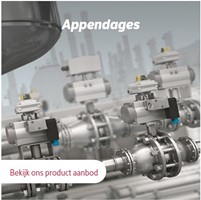
Functions of Piping Components (Appendages)
Appendages perform four core functions in installations. Below you’ll find a brief explanation per function with examples and internal links.
Shut-off
Shut-off valves start or stop the flow and let you safely isolate sections for maintenance or emergencies. Examples: ball valves (fast quarter-turn), butterfly valves (low pressure drop on large diameters), gate valves (full bore), needle and globe valves (fine control).
Control
Control appendages (e.g., pressure reducing/pressure control valves, proportional and motorised valves) stabilise pressure, temperature and flow and prevent fluctuations. With positioners and IO-Link/4–20 mA you can integrate easily into your control system.
Protection
Safety valves, check valves and relief valves protect against overpressure and unwanted backflow. In steam and gas systems, steam traps and flame arresters/safety devices prevent hazardous situations and production losses.
Common Types of Appendages
The categories below cover most real-world needs. Click through to product pages for specifications and selection help.
Shut-off & Control Valves
- Butterfly valves – cost-effective for larger DN, short face-to-face, suited for water/steam (with the right seat).
- Gate valves – full bore, low pressure drop, common in water and utility networks.
- Ball valves – quarter-turn, tight shut-off, wide media range (stainless/steel/bronze/PTFE seats).
- Diaphragm valves – hygienic, low dead-space, ideal for clean steam/food.
- Control valves – linear/equal-percentage trims for accurate process control.
Safety Devices
- Safety valves – open at a defined set pressure; PED/CE compliant.
- Relief valves – controlled pressure reduction/bypass to protect equipment.
- Check valves – prevent backflow and water hammer (with damping/soft-close options).
Measuring & Control Equipment
- Pressure gauges & transmitters – local readout and signals for monitoring.
- Flow meters – volumetric or mass, including totalisation and leak/alarm functions.
- Temperature transmitters & controllers – stable process heating and alarm monitoring.
Filters, Air Vents & Strainers
- Y-strainers & basket strainers – protect valves/metering from debris.
- Air vents/deaerators – remove air/gases for stable measurement and pump protection.
Applications of Appendages
Each sector has specific requirements for materials, certification and cleanability. A few real-world examples:
Process Industry (chemicals, pharma, food & beverage)
Sanitary diaphragm valves and cavity-filled ball valves with 316L/electropolished finish minimise dead space. Clean-steam control valves and stainless instrumentation safeguard product quality and validation. Traceability via IO-Link or digital protocols makes maintenance predictable.
Buildings & Infrastructure (water, HVAC, utilities)
Gate and butterfly valves for distribution; pressure-reducing and relief valves for comfort and safety; air vents and strainers reduce faults. Rotameters/ultrasonic flow meters support consumption monitoring and energy savings.
Steam, Heat & Energy
Vortex/ultrasonic flow measurement, steam traps and safety valves are essential for efficiency and safety. Water hammer control with dampers/guiding prevents damage to appendages and pipework.
Marine & Offshore
Corrosion-resistant materials (duplex stainless/bronze), compact butterfly valves and spring-loaded check valves for vibration-rich environments. ATEX-rated actuators where required.
Clean Steam / Culinary Steam
Appendages compliant with EHEDG/3-A, with hygienic connections (Tri-Clamp), food-grade seals (EPDM/PTFE/FFKM) and fully drainable designs to prevent contamination.
Quality, Certifications & Selection Criteria
The right selection prevents downtime and ensures compliance. Use the checklist below as a starting point.
Certifications
- CE / PED – European pressure equipment conformity.
- EHEDG / 3-A – sanitary design for hygienic processes.
- ATEX – for explosive atmospheres (actuators/sensors).
- Materials & traceability – 3.1 certificates, FDA/EC 1935/2004 for food contact.
Materials & Design
- Stainless steel 316(L), carbon steel, bronze or plastics (PVDF/PP) to match medium and temperature.
- Elastomer selection (EPDM, FKM, PTFE, NBR, FFKM) aligned with chemical resistance.
- Low-dead-space design and proper surface finish for clean/sterile processes.
Selection Criteria & Checklist
| Aspect |
To verify |
| Medium |
Water, steam, (process) gas, clean steam; chemical compatibility and particles/viscosity. |
| Pressure & temperature |
PN/ANSI class, continuous & peak conditions; water hammer/vibration present? |
| Connections |
Flange (EN/ASME), thread (BSP/NPT), Tri-Clamp, welded ends; face-to-face length. |
| Control characteristic |
On/off or modulating; required Kv/Cv and turndown; actuator/positioner. |
| Standards & certificates |
CE/PED, EHEDG, ATEX, FDA, 3.1 material certificates. |
| Maintenance |
Replaceable seats/seals, spares availability, CIP/SIP resistance. |
Installation & Maintenance
Reliability starts with correct installation and periodic care. Install appendages stress-free, with proper alignment and gasket compression; avoid flange torsion and ensure guides/anchors are in place to damp water hammer and vibration. Clean strainers after commissioning (debris), test switching and tightness, and perform a pressure/leak test before handover.
Plan risk-based inspections: function-test safety valves and steam traps monthly to quarterly; inspect control valves and check valves semi-annually to annually. Log findings and replace wear parts (seats, seals, springs) proactively. Condition monitoring (pressure/flow/temperature) helps detect deviations early.
Tip: many faults trace back to contamination and mis-sizing. A short audit (Kv/Cv check, set pressures, air quality) immediately saves energy and failure costs.
Need Advice or a Quote?
Our specialists help you select the right type, material, Kv/Cv and standards-compliant design. Many products ship from stock or on short lead time.
Request free advice
Frequently Asked Questions about Appendages
What is the difference between a valve and an appendage?
Appendage is the umbrella term for components that measure, control, shut off or protect; a valve is one type of appendage used to stop, start or meter flow (e.g., ball, butterfly, globe or gate valves).
Which appendages are mandatory in a potable water installation?
Typically at least: a main shut-off valve, backflow prevention (check valve/safety group appropriate to risk), pressure protection on hot water (combination/relief valve) and pressure reduction where needed. Follow EN 1717/EN 806 and, in the Netherlands, NEN 1006 plus appliance instructions.
What is the difference between a safety valve and a relief valve?
A safety valve opens abruptly at set pressure (rapid pressure release, typically steam/gas). A relief valve opens gradually and maintains a set pressure (commonly on pump lines/liquids).
How do I determine the right Kv/Cv for my valve?
Use required flow, allowable pressure drop and medium properties to calculate Kv/Cv. Consider operating and peak conditions and choose sufficient turndown. We can calculate this for you.
Which materials should I choose: stainless steel, carbon steel or bronze?
Stainless 316(L) for corrosive/clean media; carbon steel for general industry and higher pressure/temperature; bronze for drinking-/seawater. Select seals (EPDM, FKM, PTFE, FFKM) to match medium and temperature.
How do I prevent water hammer and vibration?
Size for realistic velocities, avoid sudden closure, use dampers/soft-close check valves, and ensure proper guiding/anchoring. Consider slow-opening actuators where relevant.
How often should I inspect appendages?
Risk-based: safety-critical appendages monthly–quarterly, control/check valves semi-annually–annually. Increase frequency with high loads, contamination or critical processes.
Can appendages be retrofitted into an existing system?
Yes, provided pressure/temperature class, materials and connections (EN/ASME, BSP/NPT, Tri-Clamp) are compatible. Verify face-to-face dimensions, Kv/Cv and perform a pressure/leak test after installation.


