Applications
- Pump bypass & minimum flow: protection against overheating, cavitation, or mechanical damage.
- Process lines in food and general industry: stable supply pressure for valves, pneumatic components, or dosing points.
- Filtration/CIP loops: constant inlet pressure with varying resistance.
- Materials/media: available in stainless steel, PVC-U, PP, and PVDF for water, process fluids, and chemicals (depending on compatibility).
Materials, connections & range
- Materials: stainless steel (hygienic/corrosion-resistant), PVC-U/PP/PVDF (chemical-resistant, lightweight).
- Connections: female/male thread, solvent weld, or flanged connection (DIN/ANSI depending on model).
- Set ranges: various spring ranges (low to high pressure). Check range, temperature, and medium compatibility.
Need to monitor pressure? Combine with a pressure gauge or digital pressure sensor for adjustment and monitoring.
Selection: how to choose the right valve
- Set pressure (inlet pressure): desired minimum pressure in the source circuit.
- Bypass capacity: how much bypass is needed at maximum demand? Use the Kv/Kvs of the valve and your process data.
- Medium & temperature: choose material and sealing suitable for chemical and process conditions.
- Installation & direction: follow flow direction; prevent sand layer/fibers without filter.
- Function: only pressure holding (direct acting) or more precise (pilot operated) for large flows/rapid fluctuations.
Not sure whether to choose pressure holding or reducing? See also: pressure reducing valves.
Installation & adjustment (practical tips)
- Placement: in the bypass/return line. Keep straight inlet and outlet sections where possible (manufacturer’s advice).
- Measurement: place a pressure gauge or pressure sensor upstream of the valve to read the set pressure correctly.
- Adjustment: turn the adjusting screw until the desired inlet pressure is reached under operating conditions; lock the setting.
- Check: vary consumption and check if the upstream pressure remains stable.
- Maintenance: if “leaking”, first check for contamination or damaged seat/seal; also check flow direction.
Pressure sustaining valve / relief valve
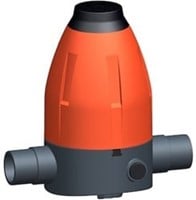
A pressure sustaining valve (also called a relief valve) ensures that the pressure before the valve is maintained. This means that the valve closes in case of excessive demand to keep the pressure before the valve constant. When the inlet pressure is below the set value, the valve remains closed; once the set pressure is reached, the valve opens to maintain constant upstream pressure.
Available in stainless steel, PVC, PP, and PVDF.
A relief valve is often confused with a safety device.
Difference between relief valve and safety valve
See here the difference between a safety valve vs overflow / relief valve
The opening characteristic of a relief valve, overflow valve, pressure sustaining valve, or pressure release valve is shown below. A relief valve may, in principle, vent continuously and is therefore often used as a bypass on pumps to prevent the pump from pumping against a closed valve.

- Set pressure is reached; relief valve is still closed.
- Set pressure is exceeded; valve opens proportionally to the overpressure.
- At the required bypass flow, the valve stabilises itself.
- As system pressure decreases, the relief valve starts to close again.
- System pressure continues to drop and the valve closes further.
- At a pressure slightly below the set pressure, the valve is fully closed again.
Fixed points are: 1 and approximately 6.
FAQ
What is a pressure sustaining valve?
It keeps the pressure before the valve at a set value by opening proportionally when exceeded and bypassing flow. Typical use: pump minimum flow and distribution loops.
How do relief/bypass valves work?
Spring- or pilot-operated. When upstream pressure exceeds the setpoint, the valve opens proportionally and diverts flow; as pressure drops it closes. This keeps the upstream pressure within band.
What’s the difference between a relief valve and a safety valve?
A relief/sustaining valve regulates pressure proportionally for process stability. A safety valve is a protection device that opens abruptly to protect equipment from excessive pressure.
Where should I place a bypass/overflow valve?
In a bypass or return line, parallel to the consumers, following the flow arrow. Measure pressure on the upstream side for accurate setting.
Why is my relief valve “leaking”?
Common causes: debris on seat/seal, wrong installation direction, incorrect spring range/setpoint, or cavitation/shock. Clean, verify direction and setpoint; replace damaged parts if needed.
Can I adjust a relief/sustaining valve?
Yes—set under operating conditions with a reliable upstream measurement, choose the correct spring range and lock the setting.


